Venu BMS Platform: Battery management engineered for US and EU energy storage.
The Venu BMS Platform is a three-tier battery management system for battery energy storage systems (BESS). US and EU silicon, on-site battery optimization, a fail-safe SIL 2-compliant architecture, early arc and fire detection, an offline-readable battery passport and secured firmware.
Talk to an engineer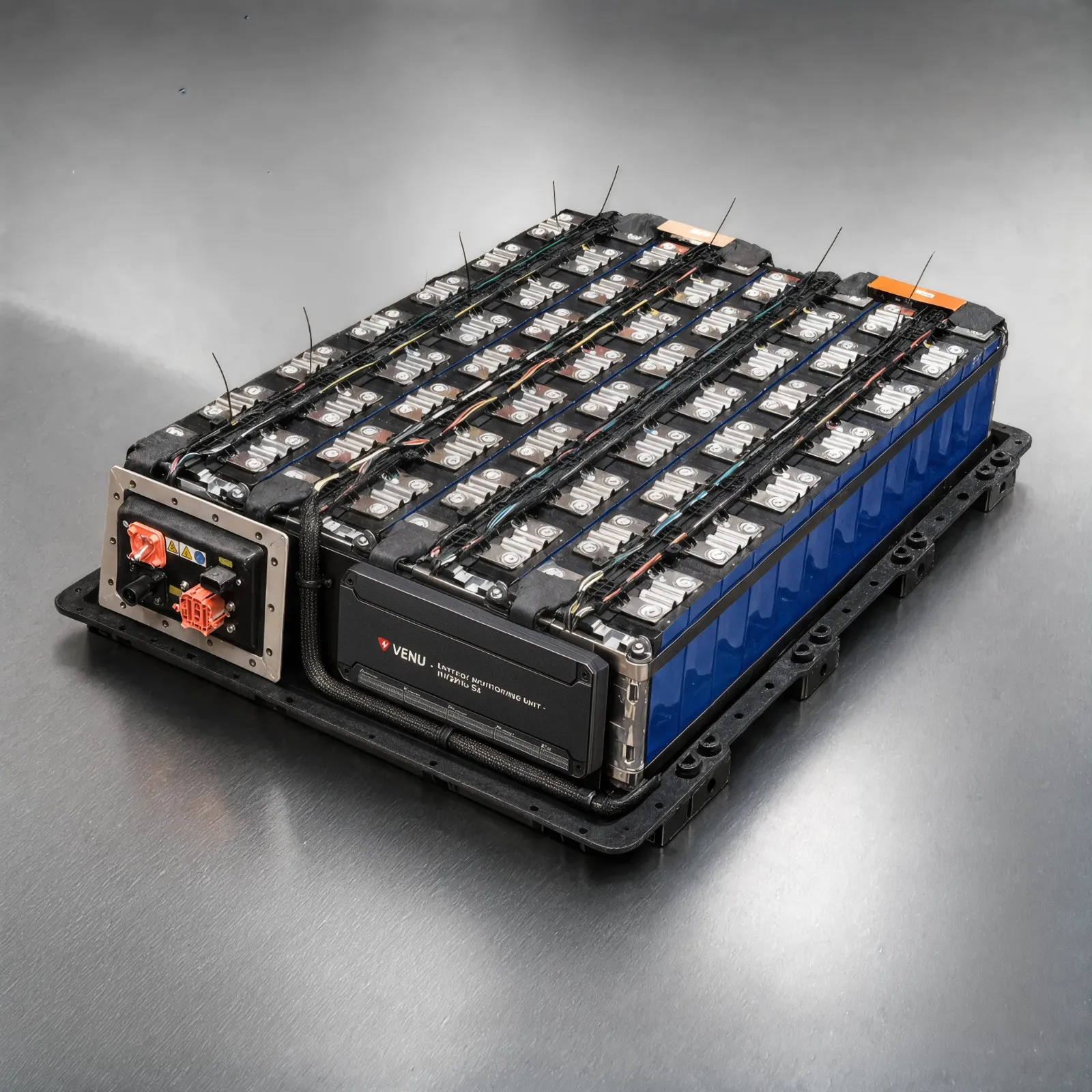
At a glance
- US / EU silicon
- 100%
- Cell accuracy
- <2 mV
- Balancing
- 600 mA
- Compliant
- SIL 2
- Arc and fire detection
- Early
- Cycle life
- +13%
Key features
- Compliance and supply
US and EU compliant. Built on US and EU silicon.
Every IC on every board comes from US and European semiconductor manufacturers. Designed to US and EU standards.
- Optimization
Unified BMS and local EMS. Optimization at the source.
The GPU-equipped BAU combines AI cell models, impedance tracking, <2 mV cell measurement and 600 mA balancing. Decisions are made on site and offline — no cloud dependency, no remote attack surface. Encrypted high-speed CAN FD; EU Cybersecurity Act compliant.
- Functional safety
Fail-safe. Redundant. SIL 2 compliant.
A hardware safe-state contactor path independent of software, dual-path cell and current measurement, insulation monitoring and HVIL.
- Early detection
Early arc and fire detection.
In-pack gas and pressure analysis with AI flags cell venting before thermal runaway; the same sensing detects arcing inside the HV Box.
- Battery passport
Battery passport data, readable from offline packs.
SOC, SOH and cycle history can be retrieved from de-energized or disconnected packs — for second life, warranty and EU Battery Regulation passport requirements.
- Firmware security
Encrypted end to end. Secured from boot to update.
Every BMU, BCU and BAU carries a hardware secure element. Keys never leave the chip; every CAN FD message is encrypted and authenticated end to end. Secure boot, signed and encrypted firmware, authenticated update chain.
Cycle life
13% longer cycle life in standard arbitrage operation.
Cell models constrain every charge and discharge decision in real time.
Integration
BMS, EMS and PCS on a single control architecture.
One data model and one optimization loop from cell to grid.
Measurement
Dual-path cell measurement. <2 mV lifetime error.
Two independent ADCs per cell; 600 mA passive balancing without thermal derating.
System architecture
Three tiers: BMU per module, BCU per string, BAU per system.
One data model and one optimization loop from cell to grid. Designed in Istanbul, manufactured in Kocaeli.
EMS · PCS · SCADA
Cloud monitoring
BAU · System controller
Linux edge controller · NPU
SOC/SOH, power limits, logs, OTA
CAN FD, encrypted
BCU · String 1
Current, HV, insulation
3 contactors · HVIL
Isolated CAN · 24 V
One BMU per 13S module, daisy-chained
BCU · String N
Current, HV, insulation
3 contactors · HVIL
Isolated CAN · 24 V
One BMU per 13S module, daisy-chained
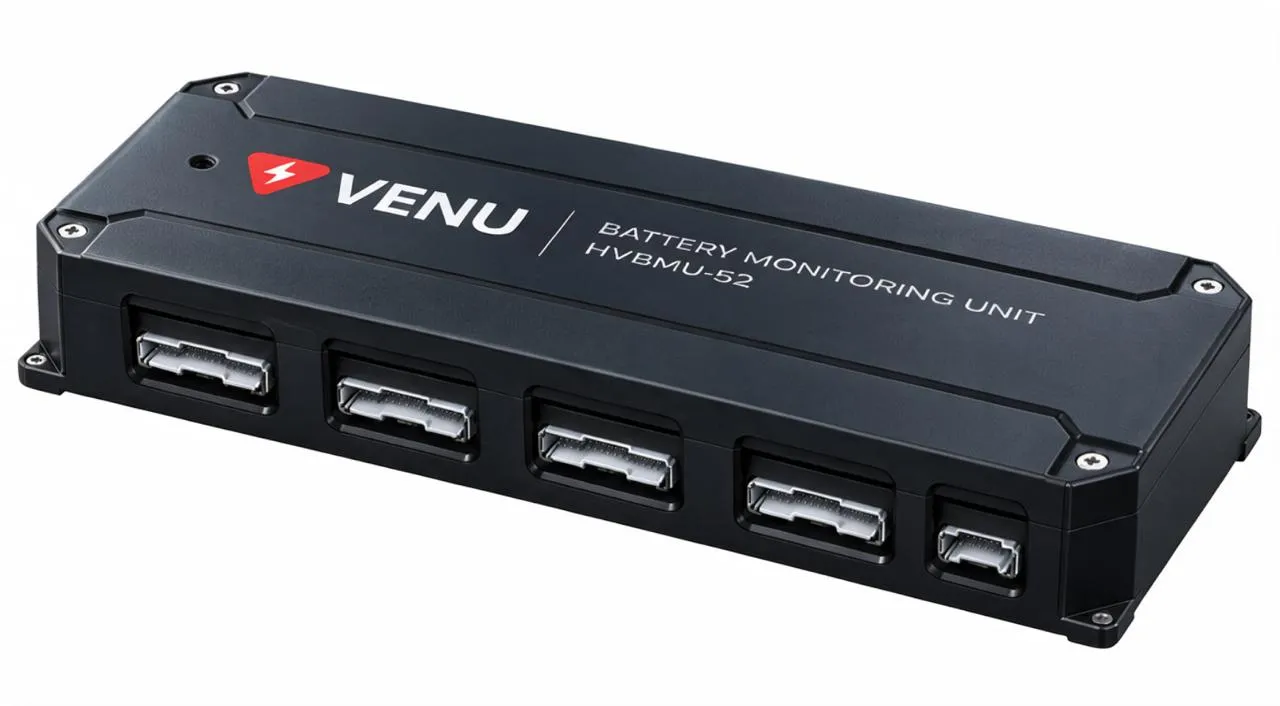
Venu BMU Battery Management Unit · module board: Dual-path cell monitoring with in-pack gas analysis.
Module-level unit: two independent ADCs per cell, <2 mV lifetime error, 600 mA passive balancing, impedance tracking.
| Cell monitoring IC | Automotive-grade cell monitor, 13S per module |
|---|---|
| Measurement accuracy | ±1.8 mV @ 3.3 V/cell; <2 mV lifetime, −40 … +105 °C |
| ADC architecture | 2 independent ADCs, simultaneous and redundant |
| Passive balancing | 600 mA / cell, programmable PWM |
| In-pack sensing | Gas sensing + automotive-grade NXP pressure sensor; detects the pressure rise of cell venting before thermal runaway, AI-based early warning |
| Communication | Encrypted high-speed CAN FD via on-board secure element; isoSPI 2 Mbps, 20 m per segment |
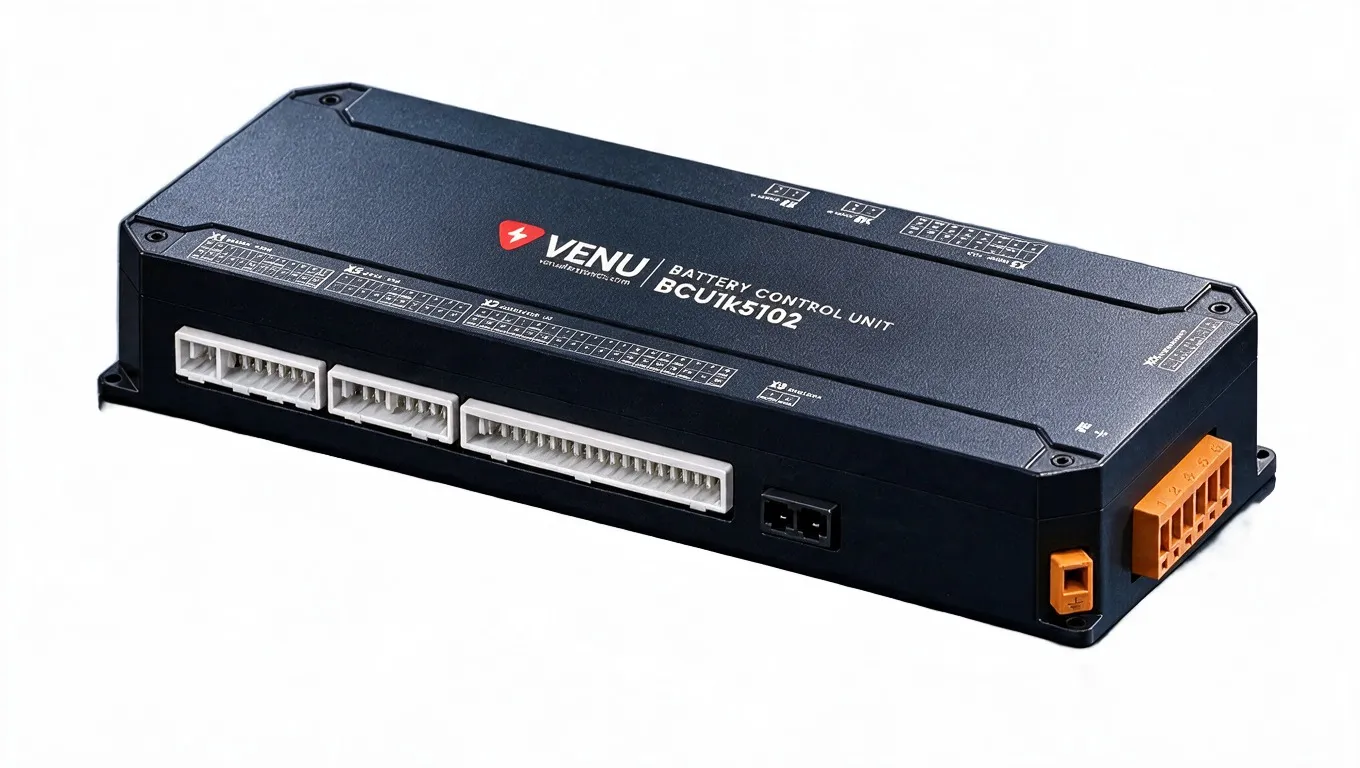
Venu BCU Battery Control Unit · string controller, HV Box: Fail-safe string control and high-voltage protection.
String controller: hardware fail-safe contactor drive, redundant current sensing, insulation monitoring, HVIL and arc detection.
| Microcontroller | NXP automotive-grade, AUTOSAR-ready MCU; dual Arm Cortex-M7 in lockstep, ASIL D capable, hardware security engine |
|---|---|
| String measurement | Pack monitor IC: redundant current (shunt + CT/Hall), 3 HV voltage channels |
| Fail-safe path | Hardware safe PWM gating + driver FS outputs + external watchdog |
| Insulation monitoring | Real-time, two-way insulation resistance measurement: BAT+ to chassis and BAT− to chassis measured independently and continuously |
| Gas / ambient sensor | MEMS gas, temperature, humidity and pressure sensor — arc and overheating detection |
| Cybersecurity | Hardware secure element on every device: ECC P-256 keys stored in tamper-resistant hardware, every CAN FD message encrypted and authenticated end to end, secure boot |
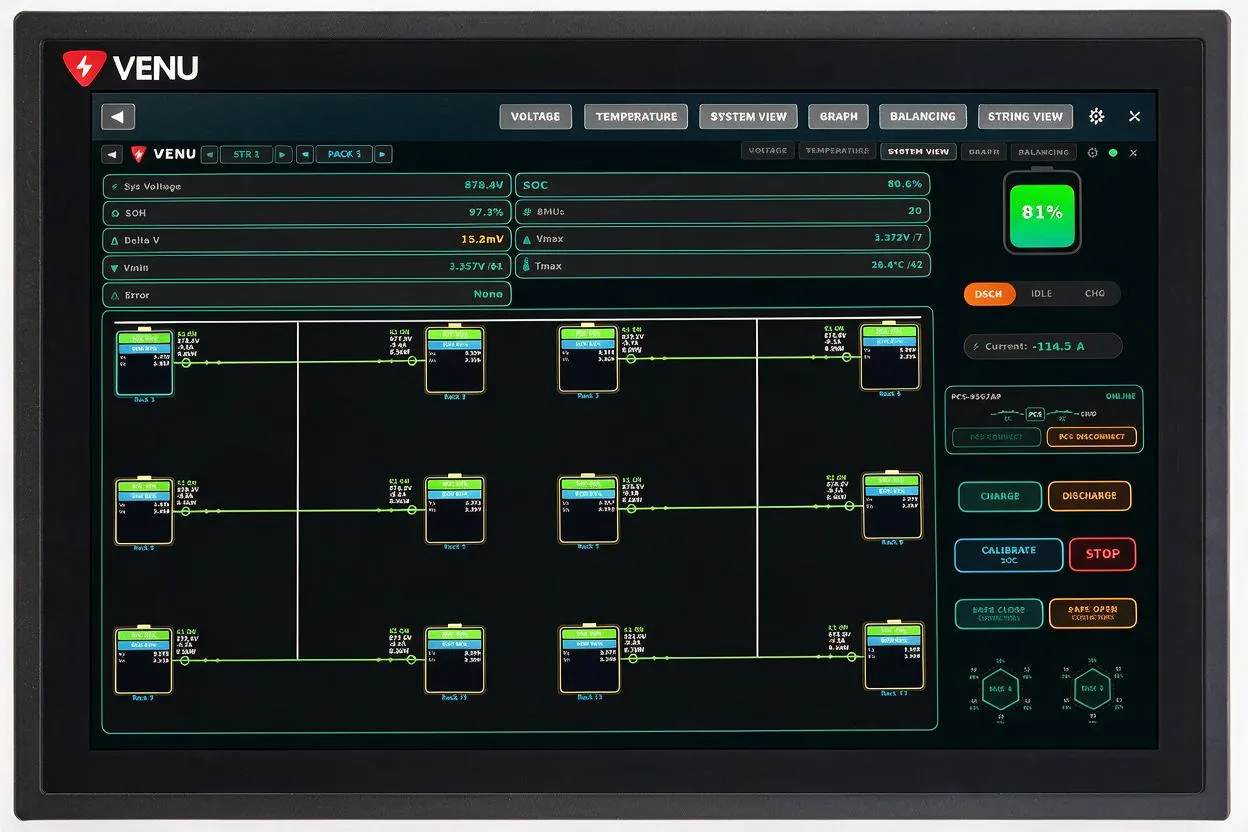
Venu BAU Battery Aggregation Unit · system controller: Cell-model-based optimization at the edge.
System controller: the on-board GPU and NPU run cell models in real time; 13% longer cycle life in standard arbitrage operation.
| Processor | Dual-core Arm Cortex-A35 @ 1.5 GHz + real-time Arm Cortex-M cores |
|---|---|
| AI / graphics | NPU 1.35 TOPS; 3D GPU |
| Interfaces | 3 × Gigabit Ethernet, isolated RS-485, isolated CAN FD |
| I/O | Digital inputs and outputs, PWM, relay and motor drivers |
| Display | 13.3″ IPS capacitive touch, 1920 × 1080, HDMI |
| Protocols | Modbus TCP/RTU (PCS, EMS, SCADA) |
| Cybersecurity | Hardware secure element, end-to-end encrypted CAN FD, secure boot, TrustZone, DDR encryption, tamper detection, signed OTA |
| Operating temperature | −40 °C … +85 °C |
Compliance
SIL 2 and CE compliant. Ready for US and EU markets.
IEC 61508 SIL 2
Functional safety (BMU / BCU safety functions)
SIL 2 compliant
CE (EMC + LVD)
EU market
CE compliant
IEC 62619
Industrial Li-ion battery safety
Compliant
UL 1973 / UL 9540
US stationary storage battery / ESS
US compliant
EU Cybersecurity Act
Product cybersecurity
Compliant; encrypted communication
CISPR 32 / IEC 61000-6-4
EMC emissions
Pre-compliance tests passed
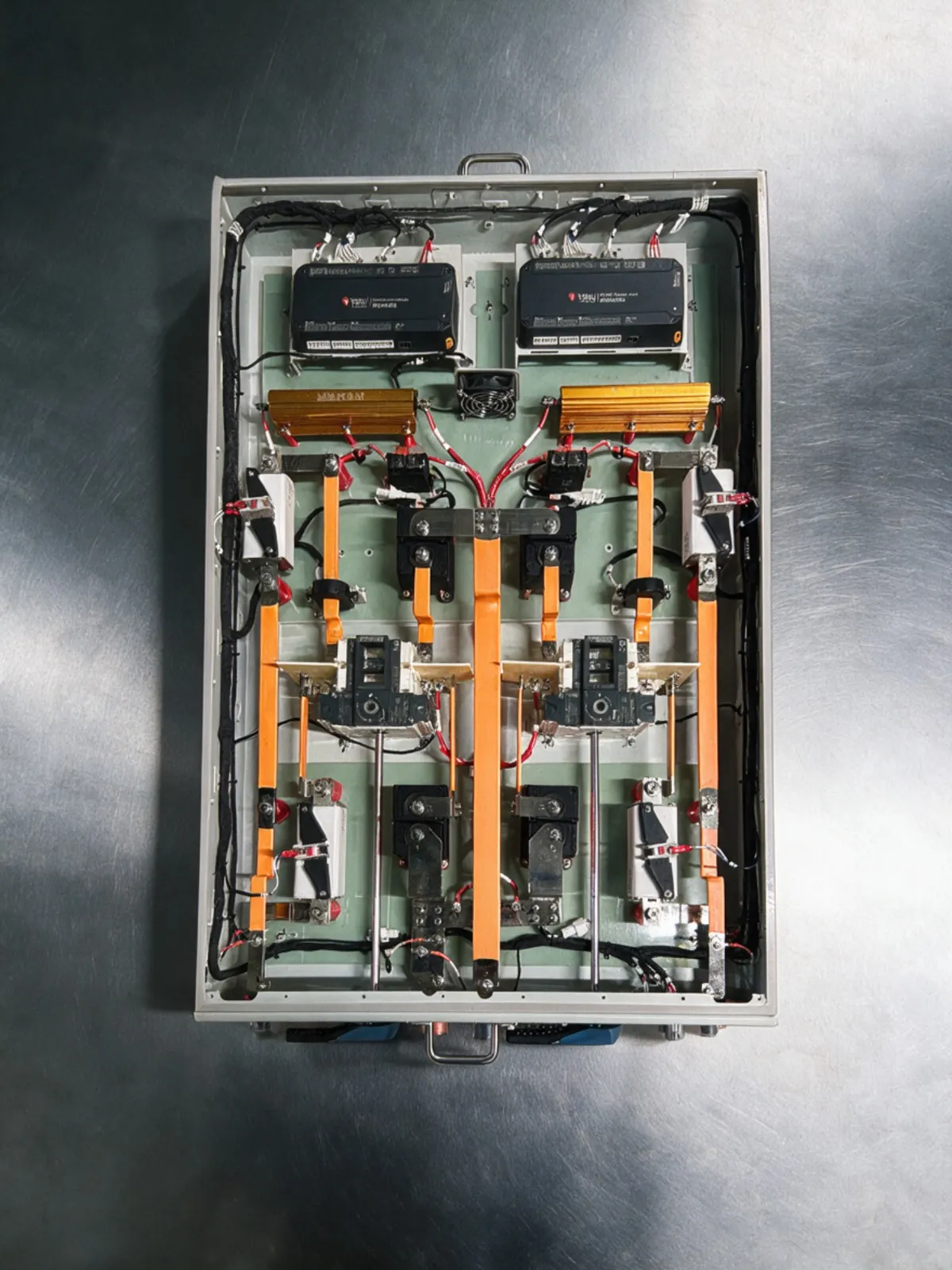
Fail-safe architecture
- Fail-safe contactor drive: hardware safe-state path independent of the MCU + external watchdog
- Redundant cell measurement: two independent ADCs, simultaneous
- Redundant string current: shunt + CT/Hall cross-check
- Contactor feedback: antivalent auxiliary contacts and fuse trip detection
- Insulation resistance monitoring: real-time, two-way: BAT+ and BAT− to chassis measured independently
- HVIL interlock loop: MSD, cover, HV connector
- Open-wire diagnostics
- Thermal runaway early warning: in-pack gas + pressure; arc detection in the HV Box
Supply chain
Zero China-origin silicon.
Every IC on every board comes from US and European semiconductor manufacturers, supporting FEOC requirements for US projects.
| Manufacturer | Role | |
|---|---|---|
| Analog DevicesUS | US | Cell and pack monitoring, isolated daisy-chain communication, real-time clock |
| NXPEU | EU | Automotive MCU, pressure sensing, contactor and high-side drivers |
| Texas InstrumentsUS | US | Digital isolation, isolated CAN, solid-state relays, supervisors, isolated power |
| MicrochipUS | US | Hardware secure element on every device (ECC P-256, tamper-resistant key storage), memory |
| Digi InternationalUS | US | Industrial system-on-module |
| STMicroelectronicsEU | EU | Microcontrollers and application processor |
Frequently asked questions
What are the three tiers of the Venu BMS Platform?
A BMU on every 13S module measures each cell through two independent ADCs and balances it at 600 mA. A BCU on every string, housed in the HV Box, handles current, high voltage and insulation and drives the contactors through a hardware fail-safe path. A BAU per system runs the cell models and connects to EMS, PCS and SCADA over Modbus TCP/RTU.
Does the Venu BMS Platform depend on a cloud connection?
No. The BAU makes its decisions on site and offline — there is no cloud dependency and no remote attack surface.
Can battery passport data be read from a pack that is switched off?
Yes. SOC, SOH and cycle history can be retrieved from de-energized or disconnected packs, for second life, warranty and the passport requirements of the EU Battery Regulation.
Where do the semiconductors come from?
Every IC on every board comes from US and European semiconductor manufacturers. Key suppliers include Analog Devices, NXP, Texas Instruments, Microchip and STMicroelectronics, with an industrial system-on-module from Digi International. There is no China-origin silicon, which supports FEOC requirements for US projects.